Robert Knox, 1815 – 1877

A self-proclaimed Moral Force Chartist, Robert Knox represented Durham at the First Chartist Convention from February to September 1839. After migrating to Australia, he became a member of his local town council.
Born in 1815 at Duns or Dunse, some fifteen miles west of Berwick-upon-Tweed in the Scottish borders, Knox began work at the age of eleven, and came south to Bishopwearmouth, now part of Sunderland, as a young man in search of work around 1837. A slater by trade, he evidently found employment, and was involved in the mechanics’ institute, the leaders of which were to form the core of the local Chartist movement.
By late 1838, he had been elected secretary of the County Charter Association, sharing the role with John O’Neil, another Sunderland radical. He was evidently well known locally: a profile in one Chartist newspaper noted that he had previously served as secretary to a temperance society in the town.
That December, Knox was among the speakers at a series of outdoor meetings, including at the coal-mining villages of Hetton-le-Hole and Hylton on Christmas Day. These pit-head meetings drew the ire of the Durham Chronicle, which claimed speakers had used seditious language to incite the people “to the destruction of property and other acts of illegality”.
In a subsequent letter to the paper Knox and O’Neil claimed that this was untrue (Durham Chronicle, 12 January 1839, p2). The Chronicle, which would remain hostile to Chartism, stood by its allegations, claiming to have received its information from a reliable source.
Knox was elected to represent Durham at the First Chartist Convention. He was present at the opening session on 4 February, where he handed in petition sheets carrying 4,500 names for the national petition, and a contribution from the Durham Chartists of £10 towards the National Rent. The Rent was intended to help fund delegates’ presence in London (The Operative, 10 February 1839 p.3).
Though not among the leaders of the convention, Knox played an active part in its proceedings, seconding James Bronterre O’Brien’s move to distance the convention from agitation to repeal the corn laws, and as chair of a number of sessions.
The Charter newspaper, effectively the voice of the London Working Men’s Association and then of the convention itself, printed a series of sympathetic biographies of delegates along with woodcut portraits, among them in its issue of 24 March 1839, one of Robert Knox.
It described the Durham delegate as “about five feet ten in height”, and “of a comparatively slender frame”. It added: “There is an air of melancholy in the expression of his face, which would induce a belief that he is a man of sorrows; but even a slight acquaintance with him is sufficient to prove that he possesses a heart full of kindness, and that, with a large capacity for sympathy, he is fitted to enjoy pleasure and communicate it liberally to others.”
The Charter suggested that Knox was no orator: “We have never heard Mr Knox deliver what may be termed a speech, and we incline to think that public speaking is not his forte.” But in this it may have been mistaken. The following month Knox received permission from the Convention to head back to Durham to consult his constituents and proselytise for the cause. He would spend much of the late spring and summer in the North, speaking with some eloquence at a series of well-attended meetings.
At Town Moor in Newcastle, he set out his political principles:
“I am one of those who are called Moral Force Men. But I say this, that when a nation demands her rights, no particular section of that nation has a right to withhold them from the majority. I say further, that the majority has a right to use any means that will gain those rights. If fighting in the field with the pike or the musket would get those rights, the people have a right to use the pike and the musket. (Loud and continued cheering.) But in saying this I have no design to advise you to get your rights by the use of the pike and the musket, so long as there are other means left untried which may make our oppressors comply with them without shedding a drop of blood. Let us – if we can get our holy object bloodless and stainless – let us leave the bayonet and the canon to those physical force men who have used them from the beginning of time, that is our present governors. (Loud cheers)” (Northern Liberator, 25 May, 1839).
At this same meeting, he also “observed that moral and physical force were so nearly allied to each other, that they might be called twin-brothers” (Newcastle Courant, 24 May 1839).
The Convention tied itself in knots that summer over the ulterior measures that should follow the rejection of the petition, dividing not just over the fundamental issue of moral versus physical force but also over the “sacred month” or general strike.
Knox had advised the Convention that although his constituents had pledged to keep the month, he did not believe they were ready to do so (Northern Liberator, 14 September 1839). In the event, the Convention scaled down the strike from a month to a few days, and even then it was not widely observed.
The Durham Chronicle reported that Knox had resigned from the Convention, branding his fellow delegates “humbugs” (17 August 1839, p2). However, this was premature as he remained a delegate until 6 September, just a week before the Convention was finally dissolved.
Knox appears to have had no further involvement in Chartism. But he did not disappear entirely from the public record. Almost exactly a year after his resignation from the Convention, on 7 September 1840 Knox married Eliza Bird at St Michael and All Angels, Bishopwearmouth.
Knox returned to his trade and the young couple moved to Glasgow, where they can be found in the 1841 census. Weeks later, on 17 June Robert (now 26), Eliza (22) and their baby boy James boarded the Thomas Arbuthnot at Greenock and sailed for Port Philip in Australia.
After arriving in Melbourne, Knox continued to work as a slater before becoming a teacher with the Church of England in Daylesford, Victoria, just as the gold rush created a dire need for educators. In 1860, he became head teacher at the school there.
Robert and Eliza had ten children, and he was finally able to pursue his political ambitions. He served on Daylesford’s first council for many years, eventually as its chairman, and championed the creation of the town’s Botanical Gardens, which still exist and are open to the public.
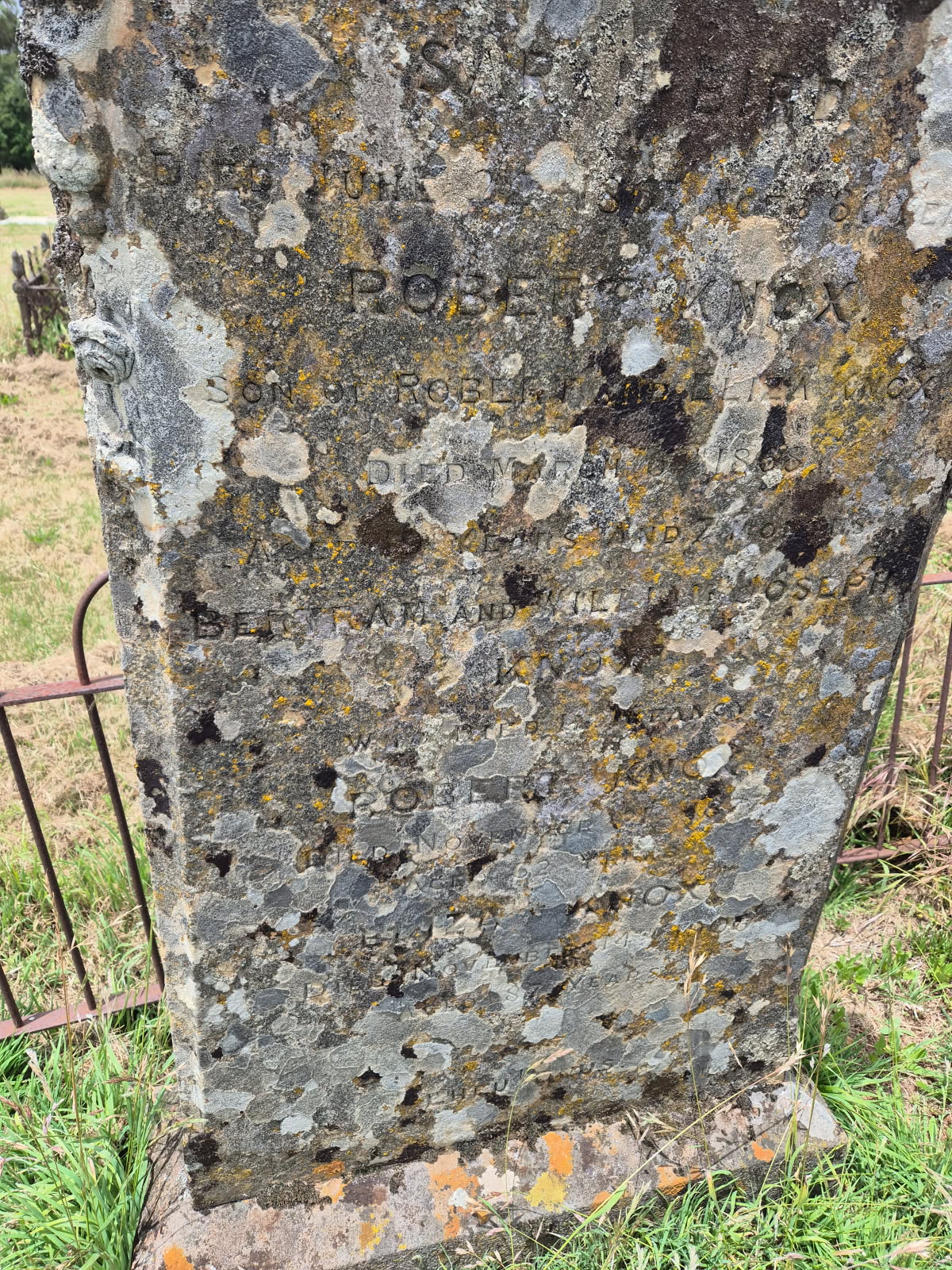
Robert Knox died on 21 November 1877, Duke Street, Daylesford, Victoria, and is buried in the town cemetery.
- I am grateful to Jemma Kinnaird, Robert and Eliza’s great-great-great-granddaughter in law for sharing her research, without which much of Robert’s life outside Chartism would have remained a mystery; and to Geoffrey Williams, Robert and Eliza’s great-great-grandson, for permission to use the photograph of Robert Knox’s grave in Daylesford Cemetery.
The profile of Robert Knox below and the portrait above appeared in the 24 March 1839 issue of The Charter.

Portraits of Delegates No. 4. Robert Knox
In the accompanying sketch, our artist has admirably succeeded in pourtraying the delegate for the county of Durham. Mr Knox, who is now in his twenty-fourth year, is a native of Dunse in the county of Berwick. He is by trade a slater, and belongs in all senses of the word to the working class. At the early age of eleven, he was obliged to submit to the toil of a labourer, and he has ever since continued to work at his trade. About two years since, he went to Sunderland to obtain employment, and the intelligence of his mind and the integrity of his character, soon procured for him the confidence of those with whom he associated. A congeniality of disposition and a similarity of pursuit introduced him amongst the members of the mechanics’ institute there, and he, for the first time, we believe, became deeply interested in political questions. The members of the mechanics’ institute at Sunderland are the leaders of the Chartist movement there; and through his intercourse with them, Mr Knox soon had his sympathies awakened on behalf of the large mass of his fellow men, whom he found condemned to unremitting toil and hopeless poverty; and his determination was at once formed to labour for their emancipation. In the month of December last, he attended several public meetings at Hetton-le-Hole, and other places in the neighbourhood, and on New Year’s Day, he was elected at a large public meeting at Sunderland, to represent the county of Durham, in the General Convention. In person Mr Knox is about five feet ten in height, and is of a comparatively slender frame; his limbs, however, appear to be well knit together, and he evinces a capability of enduring a considerable amount of hardship and fatigue. His physiognomy evinces much sternness of purpose and abstraction of thought. He would strike the practiced physionomist as being one of the Cassius class, whom Shakspeare represents as thinking much, and being to tyrants, therefore, always dangerous. There is an air of melancholy in the expression of his face, which would induce a belief that he is a man of sorrows; but even a slight acquaintance with him is sufficient to prove that he possesses a heart full of kindness, and that, with a large capacity for sympathy, he is fitted to enjoy pleasure and communicate it liberaly to others. We have never heard Mr Knox deliver what may be termed a speech, and we incline to think that public speaking is not his forte. When he does take part in any discussion, he delivers himself in the fewest possible words. He appears to delight rather in abstract speculations, and in discussing ultimate principles, than to deal with the every-day occurrences of life. He possesses much acuteness and penetration of mind, and has the enviable faculty of readily divesting a subject of all extraneous and irrelevant matter. The position which Mr Knox occupies in society has afforded him but small means of acquiring knowledge, but it is evident that he has an extensive acquaintance with the literature and history of his country. He is a zealous supporter of temperance societies, and was, for some time, secretary to the temperance society in his native town. He discharges his duties as a delegate with commendable diligence, and there is no man who possesses in a higher degree the respect and confidence of his fellow-labourers. The extent of his information, his habits of thought, his knowledge of human nature, and his modesty of demeanour, well qualify him to be a member of any deliberative assembly, and especially to do justice to the important duties confided to him in the General Convention.
[Source: The Charter, Sunday 24 March 1839]