William Paul Dowling, 1824 – 1877
Remembered for his portrait of the London Chartist William Cuffay, sketched in 1848 while awaiting transportation to Van Diemen’s Land, William Paul Dowling would go on to become a successful artist and photographer.

Born in 1824, William Paul Dowling was the seventh of eight children born to Bernard Dowling, a Dublin attorney, and Marcella McEver. After studying art at the Royal Dublin Society Dowling was drawn to London in 1845 to work as a draftsman while seeking to establish himself as a portrait painter.
Although there is no record of political activity on Dowling’s part in Dublin, the family took an interest in Irish nationalism, and in England he joined and became secretary of the Davis Confederate Club, an arm of the radical Irish Confederation which in 1847 had seceded from Daniel O’Connell’s Repeal Association and which gave organisational form to the Young Ireland movement.
By 1848, the Confederates had a strong presence in the Irish communities of Liverpool, Manchester and Salford and as both the Confederates and more radical Chartists moved towards insurrection, a joint effort in the capital would have been essential.
In the wake of the Chartist rally on Kennington Common on 10 April at which the Confederates were a strong presence, and Parliament’s off-hand rejection of the petition for the Charter, Dowling appears to have provided the bridge between the two groups, taking part in a series of meetings over the summer at which plans were drawn up for an armed rising in London.
The historian David Goodway has identified 16 occasions on which the ‘ulterior committee’ met during late July and August, at many of which Dowling was present. After making contact with Chartists in Manchester, Liverpool, Leicester, Nottingham, Birmingham and possibly Bradford, they agreed that the rising would take place on Wednesday 16 August. The localities were to meet at 8pm and to be ready to move at 9.20pm.
But the committee had been thoroughly infiltrated by police informers from the start, and at 6pm that night, police swooped on the Orange Tree public house arresting 11 men. Later, at 9pm, 13 more were held at the Angel in Southwark, and within 20 minutes more a large crowd had been dispersed at Seven Dials.
The arrests continued, and four days later Sgt Joseph Thompson stopped Dowling in Lambeth Walk and took him into custody. By then the police had already visited his lodgings, a back room on the second floor at 5 Nassau Street in Soho, where they found receipts for gun cotton and the papers of the Davis Club, including its membership list and membership cards.
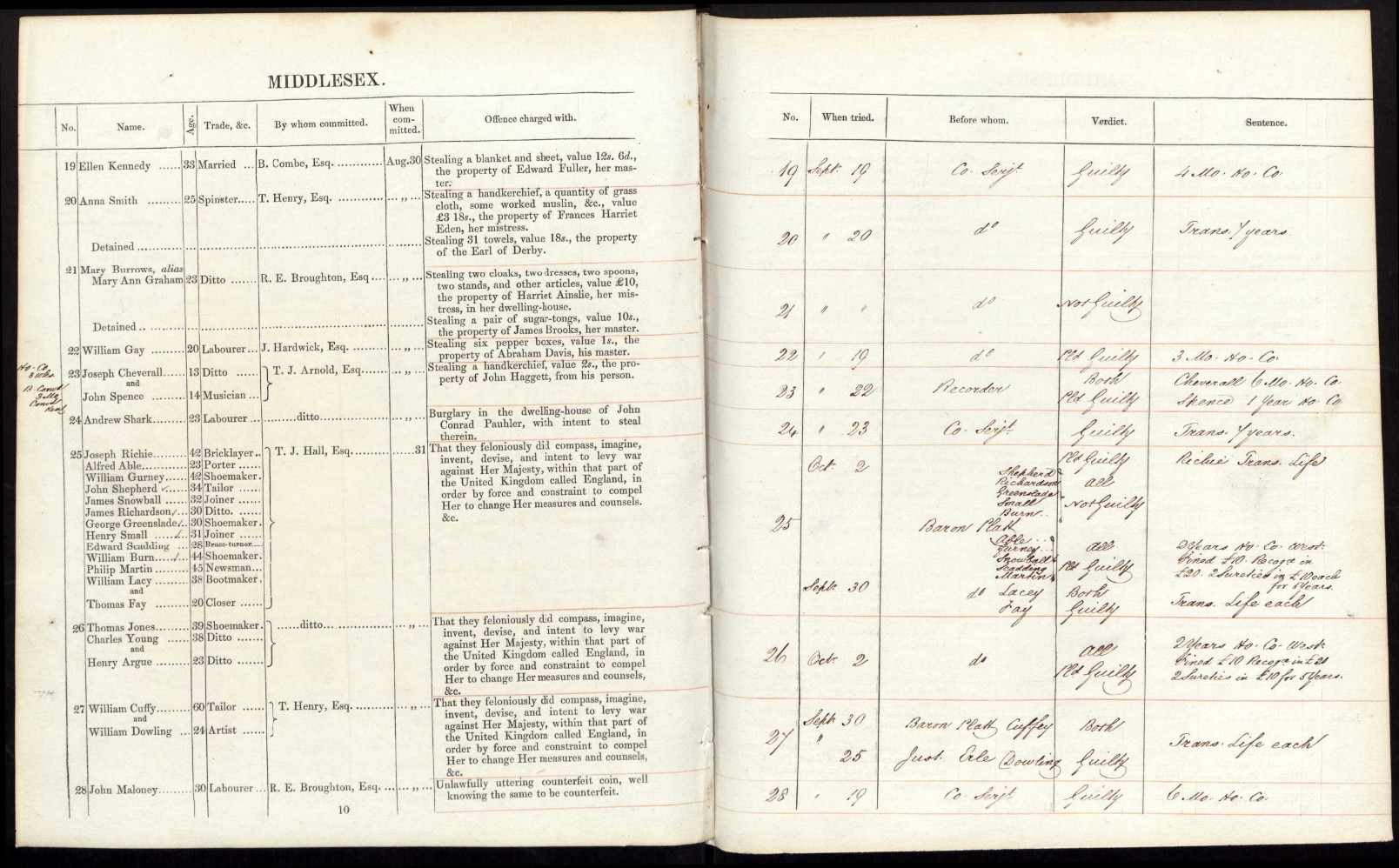
Dowling was charged with two counts of treason and put on trial at the Old Bailey. Most of the evidence against him was provided by a paid police informer named Thomas Powell, who had joined the Cripplegate Chartists under the name of Johnson and become a member of the ulterior committee. Powell gave detailed and damning evidence of the preparations being taken by the committee, and although strong doubts have been raised about the legal process, there appears to be little doubt that Dowling was guilty.
Those who knew him well were surprised by his political activities. Giving evidence at the trial, Dowling’s landlady, Dorothy Jarvis, described him as ‘a particularly quiet, inoffensive man’, and said that she had never heard him express ‘any sentiments disloyal or against the Queen, or any sentiments relative to war or fighting’. A second witness agreed. Charles Chubb, a solicitor who Dowling described as a friend, told the court: ‘I always believed him a very inoffensive man, and I did not believe he had any particular view on any political subject—he was a person of very mild demeanour—he has always expressed and conducted himself as a peaceable subject.’
Despite this, Dowling was convicted on one of the two counts aginst him, and was sentenced to be transported for life.
As was usual, Dowling and the other Chartist convicts were held in England for a year, including at Millbank Prison in London, before being transported. He told members of his family in letters home that he had spent his time making portraits of 35 fellow prisoners. One of these, his sketch of the London Chartist William Cuffay, was published in Reynolds Political Instructor (13 April 1850) and made into a print, a copy of which survives in the National Portrait Gallery.
On 8 August 1849, nearly a year after his trial, Dowling was taken from his cell and put on board the convict ship Adelaide at Woolwich, one of six men facing transportation for life for their part in the Chartist conspiracy along with William Cuffay, Wiliam Lacey, Thomas Fay, Joseph Richie and George Bridge Mullins. Stopping to take on more convicts at Portsmouth, Cowes and finally Portland, the Adelaide set sail for Hobart Town on 17 August.
They arrived on 29 November after 104 days at sea. This was a well conducted voyage, and of the 300 male prisoners who boarded the Adelaide, all but one survived the crossing. Forty men disembarked at Hobart before the ship sailed on to Sidney, including all of the Chartists, each of whom was given a ticket of leave on their arrival. This left them, within reason, free to live and work where they chose on the island without facing further incarceration or forced labour either for the government or free settlers.
Dowling swiftly found work, first with the Hobart-based lithographer Robin Vaughan Hood and subsequently on his own account, opening a studio at 9 Liverpool Street at the start of 1850. Later that year Dowling’s fiancée Julia Ann de Veaux followed him from Dublin and on 4 May they were married at St Joseph’s Catholic Church, Hobart Town.
Dowling relocated his studio a number of times in the coming years: to Launceston then back to Hobart where he occupied premises in Macquarrie Street, Davey Street, and Liverpool Street once again. Many of the portraits he painted survive today; but he also took up photography, which provided much of his bread-and-butter work between commissions.
Dowling also found time to write home with news of his fellow exiles. His letter, published in the Galway Vindicator, was reprinted by the Hobarton Guardian, or, True Friend of Tasmania (22 September 1852, p3).

In 1854, pardons were issued to some of the Young Ireland leaders of 1848, but not to Dowling. His fellow exile, Thomas Fay (now known as Thomas O’Fay) wrote to the Hobart Daily Courier (19 July 1854, p2) to point out its omission of Dowling’s name and his own from a list of Irish political prisoners. Both men, he wrote ‘acted in concert with the English Chartists in London. So that the cooperation would be simultaneous with the struggle of our countrymen and leaders in Ireland’.
The following year, Dowling applied for and was granted a conditional pardon, and this became a full pardon in 1857, enabling him to leave Tasmania and Australia if he wished to do so. Two years later, now working in partnership with his brother Matthew Patrick, Dowling relocated permanently to Launceston. The partnership did not last, however, and the brothers found themselves in bitter competition.
Dowling’s name appears in the Tasmanian newspapers on numerous occasions after his arrival – either in advertisements offering his services as a photographer and portrait painter or as a jury member. But there is little indication of any involvement in politics.
In March 1866, the Dowling family returned to Dublin, and William established a photographic studio at 20 Lincoln Place. It must have been an emotional homecoming for Dowling, who in 1849 would have expected to spend the rest of his life in exile. But with Julia Anna ill and unhappy in the relatively cold, wet climate of Ireland, they decided in 1868 to go back to Tasmania. Their eldest son Henry died at sea on the return journey aged 17, and Julia Anna herself died less than twelve months later.

Though Dowling remained active and busy at his trade, he evidently retained his attachment to Ireland. In 1875, he was elected chairman of an ‘O’Connell Centenary Scholarship Committee’. Set up in honour of the Irish politician Daniel O’Connell, it offered grants to ‘the sons of Irish parents of all denominations attending schools in Northern Tasmania’.
Dowling died on 3 August 1877 at his home in Brisbane Street, Launceston, having contracted tetanus after an operation. He was survived by just two of at least seven children: his daughter Juliana and youngest son Bernard. Juliana, who became a nun, wrote to his family in Dublin to say that that her father, a devout Roman Catholic, had died ‘peacefully and with prayer’.
Echoing the words of the witnesses at his trial back in 1848, the Cornwall Chronicle wrote in its obituary that, ‘Mr Dowling was an amiable man of quiet, retiring demeanour, very much respected, and liked best by those who were longest acquainted with him’.
Notes and sources
Throughout his time in England, William Paul Dowling uses the first name William. In Tasmania he primarily uses his middle name Paul.
The William Paul Dowling website describes itself as the ‘official family website’ and bases its biography of Dowling on family records. It sets out Dowling’s life story on a single web page but includes no contact information. Although there is every reason to take its factual account at face value, this makes it difficult to verify or follow up the limited information supplied. Accessed at https://williampauldowling.com/ (22 January 2024).
Design & Art Australia Online carries a useful biography of Dowling which looks in some detail at his work as a painter and photographer. Accessed at https://www.daao.org.au/bio/william-paul-dowling/biography/ (22 January 2026).
‘William Paul Dowling: artist, artist-photographer and photographer’ by Robert Stevens (Australiana, Nov 2020, 42:4, p28) focuses on Dowling’s work and includes numerous images of his paintings and photographs. Accessed at https://www.stgeorgeseastivanhoe.org/wordpress/wp-content/uploads/2021/01/William-Paul-Dowling.pdf (28 January 2026).
Wikipedia entries for the Irish Confederation and Young Ireland provide useful context. Accessed at https://en.wikipedia.org/wiki/Irish_Confederation and https://en.wikipedia.org/wiki/Young_Ireland (22 January 2026).
Australian newspapers cited in the text can be found on the excellent Trove website hosted by the National Library of Australia. It can be found at https://trove.nla.gov.au/.
Details of Dowling’s trial can be found at Old Bailey Proceedings Online (www.oldbaileyonline.org, version 9.0) September 1848. Trial of WILLIAM DOWLING (t18480918-2127). Available at: https://www.oldbaileyonline.org/record/t18480918-2127?text=Dowling (Accessed: 27 January 2026).
There are a number of good websites offering information about the convict ships and convicts who arrived in Australia. The National Library of Australia has a helpful list of these at https://www.library.gov.au/research/family-history/family-history-research-guide/convicts-research-guide/transportation (accessed 28 January 2026).
Books
Letters of an Irish Patriot: William Paul Dowling in Tasmania, by Margaret Glover and Alf Maclochlainn (eds), Sandy Bay, Tasmanian Historical Research Association, 2005, 142 pp. ISBN 0-909479-23-2.
London Chartism, 1838-1848 by David Goodway (Cambridge University Press, 1982).